
Paris: Travel info, tips & tricks
If you plan to visit Paris in France, here are some interesting tips & tricks and information for planning the travel.
5/8/20247 min read
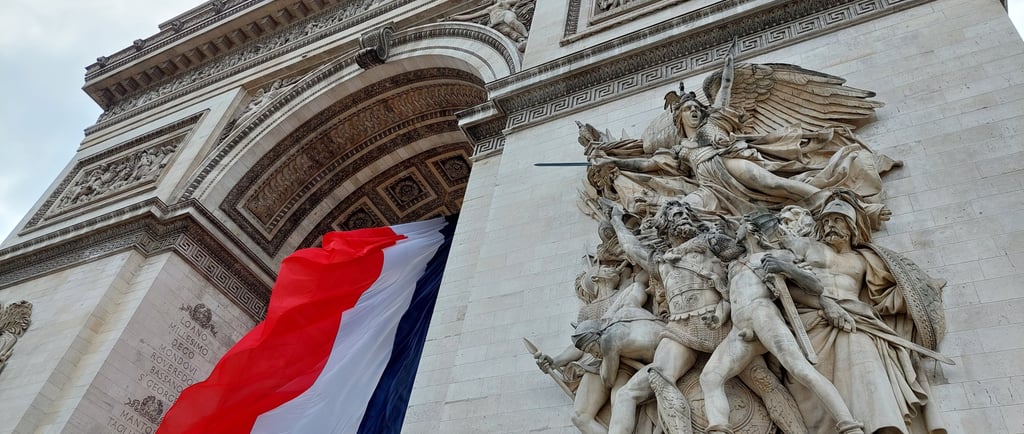
This Paris travel info is based on 10 days travel to Paris, France (including 2 in Normandy). The goal isn't to recount everywhere we went, but rather to offer some tips for all of you planning a trip to Paris and currently researching how to make the most of it, considering cost, accommodation, entertainment, and so on. So, take the following into account:
Many friends went to Paris during their summer holidays (July or August) and said it was too hot. We went from August 25th to September 3rd, and it turned out to be ideal. The daytime temperature was around 20-25°C, and at night it was about 15°C. The crowds were also significantly smaller, probably due to the start of the new school year. Of course, it's possible to hit a rainy period at that time, but we only had 1 day of rain in all 10 days. Ideal.
If you plan to visit the interior of individual attractions, and not just see them from the outside (e.g., visiting museums), it's recommended to buy tickets online a few months in advance. Of course, this applies if you're one of those who like to plan their trip in detail. Although you can buy tickets on the spot for some attractions, you'll likely wait in long queues. For some things, you can't buy tickets on the spot because everything is sold out even a month and a half or more in advance (e.g., Eiffel Tower top floor, Sainte-Chapelle church, Moulin Rouge, etc.).
As for accommodation, I believe that accommodation is great anywhere in the first few arrondissements (districts) because something is always nearby. We stayed in an apartment in the 7th arrondissement, 6-7 minutes from the Eiffel Tower and Les Invalides. An excellent neighborhood, right next to the famous Rue Cler, so that's one of my recommendations.
The cost-effectiveness of using various public transport options depends on how many days you're in Paris. If you're staying for more than, say, 4 days, we definitely recommend the Navigo Découverte weekly pass (a card with a photo that you can bring with you immediately so you don't waste time taking pictures in Paris). The card costs 5 EUR, and the weekly pass is an additional 30 EUR, allowing you to ride as much as you want in all zones (1-5). Definitely cost-effective compared to everything else. And I highly recommend using the metro, bus, or RER train as much as you can. Public transport is excellent, it runs frequently, and all key places are well connected by any of these modes of transport. If you're going for a shorter period, then it's probably better to buy regular single tickets (so-called T-Billets which cost 1.90 EUR or 1.60 EUR if you buy 10 at once). Just keep in mind that the Navigo pass is valid exactly from Monday to Sunday, not from the moment you bought it. For the following week, you can buy it on the Friday before that week.
Everything in Paris is quite expensive, from souvenirs to drinks and food. However, if you do a little digging, you'll find affordable options with prices similar to ours. There's no point in listing individual restaurants, but it's definitely most cost-effective to go to the Latin Quarter where there are many restaurants around the Saint-Séverin church. Here are two that we particularly enjoyed: La Petite Hostellerie, L'Auberge Saint-Séverin. The price of a complete menu (appetizer, main course, dessert) ranges from 12 to 18 EUR. As for food, it's not bad to try some of their specialties: frog legs, onion soup, filet mignon, duck/canard prepared in a hundred ways, quiche lorraine, etc.
Croissants, baguettes, and other bakery delicacies are superb. It's all quite expensive, but if you go to a regular store, you can get it much cheaper (e.g., 1.20 EUR instead of 2.50 EUR for one croissant). It depends, of course, from store to store, but everything is always quite fresh and delicious.
When visiting museums and other attractions, inquire about discounts or even free days. For example, the first Sunday of the month is free for most museums. Also, keep in mind that closing days are varied across museums (e.g., the Louvre is closed on Tuesdays, Musée de l'Orangerie on Mondays, etc.). Some days, museums have extended opening hours, which is good if you want to avoid crowds, as tourists traveling with agencies often leave earlier. For example, the Musée de l'Orangerie and Musée d'Orsay are open until 9:45 PM on Thursdays, and the Louvre is free on the first Friday after 6 PM, etc. There are various combinations, so you need to check as rules sometimes change.
In general, it's much, much better to go to museums early in the morning when they open (usually around 9 AM). The crowds are much smaller, not to mention the Louvre, where if you immediately go to the Mona Lisa upon entry, you can stand in the front row without any pushing and enjoy the painting, which is very difficult to appreciate if you come when it's crowded. When I say crowded, I mean "CROWDED." It's not easy to get up earlier, but it's worth it. Parisians (and tourists) sleep longer; the city only wakes up after 11 AM, and at midnight it's like midday. Cafes, restaurants – all packed.
You'll probably also come across information that it's great to walk along the Seine and "stroll" leisurely. In reality, not every part of the Seine is interesting for a walk. Currently, there's a lot of construction due to the Olympics that will be held in Paris in 2024, but the best part is the eastern side (e.g., from Île de la Cité - the island where Notre Dame is located, and further east). There, people dance tango and Latin dances, there are more benches and cafes along the river, etc. The part towards the Eiffel Tower – nothing special.
If you can, go to the Champ de Mars in the evening with a bottle of wine and glasses, lie down on the grass, and enjoy the twinkling of the Eiffel Tower, which happens every hour and lasts 5 minutes. The shows start every full hour from 9 PM until midnight.
Try to allocate more days for Paris. If you go for 4-5 days, it's a rush from location to location, and it's hard to see anything in detail (e.g., for the Louvre, if you like it, there's no point in entering without about 4 hours), and it's hard to experience that Parisian atmosphere. Truly, when you're there a little longer, hardly any city can compare to Paris. If you're staying longer, it's not a bad idea to take a short break from Paris and visit Normandy. In the middle of those 10 days, we took a 2-day rent-a-car road trip through Normandy, and it was great. Places of interest to visit: Giverny - Claude Monet's house and studio with beautiful gardens, the city of Rouen, the beaches where the Allies landed in World War II - e.g., Omaha Beach is great, the fortified town of Fougères, Chartres Cathedral, and the biggest marvel of all is Mont Saint-Michel - definitely Google it and decide! We used RentScape for car rental, booked in advance for a better price, and everything went smoothly.
If you're a fan of apps, here are a few useful ones (Moovit/Google Maps for planning and using public transport, Ou sont les toilettes/Toilet Finder - for finding free toilets, Sygic Travel - if you don't have a guide, they have text about every attraction, Duolingo - for speaking with locals, Revolut for payments, Plot+Osmand for planning offline routes, Vivino - for rating wines, Splitwise - for tracking expenses). These were all good for us, but I know there are many alternatives.
Definitely go to Versailles. You can use the RER C train line, and Versailles itself is in zone 4, meaning no special ticket is needed. We went early, and there were fewer crowds, but not all the fountains were working then. Around 3 PM - 5 PM is the best time for the fountains - most of them are turned on either continuously or occasionally.
We all have different priorities and inclinations, but personally, some of my top locations are - Moulin Rouge is awesome, although painfully expensive, the Luxembourg Gardens are great, all their museums are superb, Sainte-Chapelle church was a wonderfully positive surprise, Montmartre and the Latin Quarter, Champs-Élysées - great for strolling. Hmm, I've listed almost everything, and I've probably forgotten a lot too.
And the last recommendation is to dedicate one day to visiting the Château de Vaux-le-Vicomte. Google it a bit and check out their Saturday evening program (so-called candlelit evenings). The entire castle and all the gardens around it are illuminated with a thousand candles, and it looks phenomenal in the evening and at night. Finally, just before midnight, they set off fireworks. The castle visit is great, with an excellent audio guide, the best I've heard so far. Incidentally, this castle belonged to the Minister of Finance and "Chief Prosecutor" during the time of Louis XIV, and it's a smaller version of Versailles. Saturday evenings – romance to the tenth power! It's a bit further from Paris (about 80 kilometers), but it's in zone 5, so you can get there by RER or even TER (fast train). You arrive at Melun and then it's about 15 kilometers by UBER or taxi. You can also buy a shuttle bus ticket (you must book in advance as tickets sell out) which takes you directly from Paris there and back.
I think that's enough, and I hope I've helped someone with something (just as all of you helped me when I was preparing for my trip). If you have any questions, hit me up in the comments, and I'll reply as soon as I can. The only things we didn't manage to visit were the catacombs - we'd already been to Rome, the Centre Pompidou, Disneyland - we went without children and had already seen such things. Even in 10 days, you can't see everything if you also want to enjoy it a bit. I'm not posting pictures; surprise yourselves positively when you go there! Cheers!
Stay
Get travel tips and stories in your inbox
Contact
Follow
discovererblogmag@gmail.com
+385-91-3873-409
© 2026. All rights reserved.